


As a leader, have you ever asked yourself what makes people tick? Or asked yourself what drives people to get out of bed each morning to pursue their career goals and aspirations? If so, you are not alone! Not identifying the answers to these common questions can stifle our progression as leaders.
However, identifying them can help propel our department/organization into a level of consistency where we meet/exceed our performance goals every fiscal year. Being a leader in any capacity takes patience, commitment, and the intestinal fortitude to leave an indelible impression on our employees and colleagues alike.
So what’s the best approach to leadership to produce greater results in terms of productivity, retention, and optimal work output from our employees? The answer can vary based on our leadership style and the personality types of our employees or direct subordinates. The answer also lies in what leadership style or approach we as leaders gravitate towards naturally or respond to more effectively. Let’s take a look at six approaches to leadership used in today’s workforce as a whole.
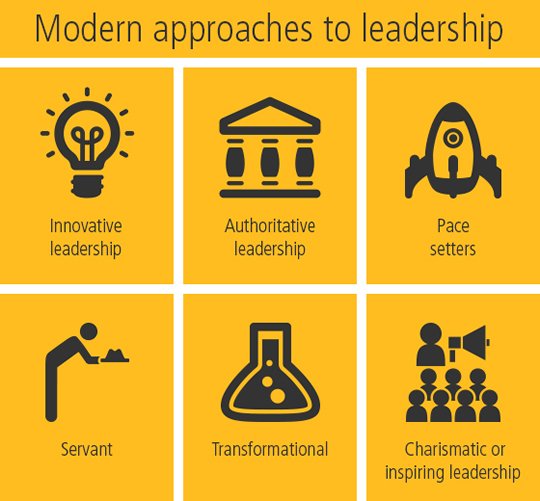
The image above from Bled School of Management outlines the six modern leadership approaches. Here’s a closer look at each leadership style from left to right:
1. Innovative Leadership. A leader who continuously looks for ways to improve processes to make them more efficient for employees and their department as a whole.
2. Authoritative Leadership. A leadership style that is more dictating when it comes to providing goals or objectives to employees without making a personal connection or taking feedback from employees in most cases.
3. Pace Setters. Are leaders that use communication as there strongest asset when it comes to setting goals, implementing change, and providing their employees with frequent updates on company policies and procedures.
4. Servant Leader. Putting the needs or necessities of their team members before their own concerns, and advocating consistently is this leader’s approach to every aspect of their position.
5. Transformational Leader. A leader who provokes motivation, positive change, and behavior within their employees and colleagues they encounter on a regular basis in the workplace.
6. Charismatic Leader. A leader who inspires employees to put their best foot forward in everything they do and strive to meet department goals/metrics on a consistent basis. These leaders are typically down to earth, vision oriented, participative, and spark positive emotion or interest in those who follow them and believe in their vision. This is the most common approach to leadership in the workplace to date.
Though all these leadership styles are impactful in their own right, the leadership approaches/styles I’ve seen the most success in throughout my career and operate in today are Servant and Charismatic leadership.
As a Veteran who served in the United States Army, I’ve seen many leadership styles that were effective and many that were not so effective when it came to productivity. I can admit that I wasn’t the greatest soldier or employee as a subordinate starting out, as I still had that “street” mentality fresh of the block.
The “you can’t tell me nothing” attitude, you know, authority issues. However, the more trouble I got myself and comrades or battle buddies into by not following the standard, the more I evaluated my approach in my new found profession as an enlisted soldier.
I’ve had leaders who barked orders and I had to obey due to their rank and my duty as a soldier to follow them. To not only do my job well, but to keep myself and battles safe/alive in real war time situations. Though I began to walk down the right path and started to take my profession more seriously, the leaders who understood where I was coming from, and took the time to listen, were the ones I gravitated towards.
The ones who listened to my grievances and gave me good advice on how to soldier, we’re always the leaders who made the most impact on my life during that chapter. I’ve found this method to be most impactful throughout my career in the workforce.
And whether I was driving an M1078 LMTV in Iraq or cleaning toilets at an assistant living apartment complex, the leaders who were empathetic and took the time to understand my point of view as an employee, we’re always the leaders who made me want to better myself.
As leaders, we can sometimes forget what our employees go through doing their everyday job tasks. Working in consumer affairs where the “customer is always right,” these tasks can be overwhelmingly daunting and can cause quick burnout if we don’t cultivate an environment where employees can decompress. We also want a work environment where the voice of our employees are heard, and met with concurrent actions that provide solutions.
Recently, I had the privilege to onboard a new class and mentor new hire employees in my department. It had been years since I took a phone call to provide customer service and do the job of my employees. Needless to say, I was a bit rusty on my first couple calls and felt like I was on the show Undercover Boss. The experience did put things back in perspective for me as my employees have a really challenging job!
I saw and see more clearly why they fuss and complain at times about their job duties and how challenging it can be dealing with customers on a daily basis. Though our focus and priority will always be providing exceptional service to our customers, we also need to make sure our employees are taken care of just as much.
I encourage and implore any leader no matter how high up in a corporation you are status wise, to take some time to engage your employees, even sit with them to witness what they do firsthand. I guarantee you and your company will benefit from it tremendously. Taking this step can show them management really cares about their needs, goals, aspirations, and development within the organization.
We can’t let our employees suffer in silence or even have a nervous breakdown like our dear friend Dwight down here from The Office.

Or even look at or talk to them with disinterest like manager of the century Mr. Michael Scott from The Office.
I love both characters on The Office and think it’s a hilarious yet insightful show that has a lot of hidden gems we as leaders can take away and implement. Ultimately, knowing who we are as leaders and what personality types our employees have within our department/organization (thinker, controller, entertainer, feeler) is vital to our growth.
It can help us develop our leadership approaches and find out which style yields the best results. Not only from a performance standpoint but from a career progression standpoint for our employees. I learned this the hard way when I moved to East TN to start a new team.
I came from leading a #1 ROCK STAR team that set the standard in our department for roughly a year and a half, so I thought starting a new team at that same level would be easy. I was SUPER WRONG about that… And though I was able to interview and hire my team, some of my candidates fooled me in the interview process. It’s really on me though as I could’ve done more to vet the applicants and asked their leaders about their productivity and overall work ethic.
We can definitely get fooled by how well someone presents themselves in an interview because we’re usually taught to put our best foot forward. Even if we get “fooled” by an applicant regarding work ethic and professionalism initially, we can still coach and help them develop positive habits or behaviors that set them up for success. Doing research on how they really conduct themselves day to day, can save us a lot of heart ache and trouble after they’re hired.
Having patience and taking the learning curve into consideration, can help us optimize proficiency or performance. I’ll save that topic for another time though. But I had to change how I approached leadership with my new team. And though they were just as competent and capable to do the job as my previous team, I had to build a relationship with each team member and build rapport to best develop and support them from there.
I did have a many obstacles to overcome in my transition, however, we eventually become the #1 team in that branch of our department after while. We also had ROCK STAR team members that really excelled in the position. It was a matter of identifying what worked with this specific team and finding an approach that catered best to them. Below is a look at personality types in the office and how we can further set our employees, and ourselves up for success:
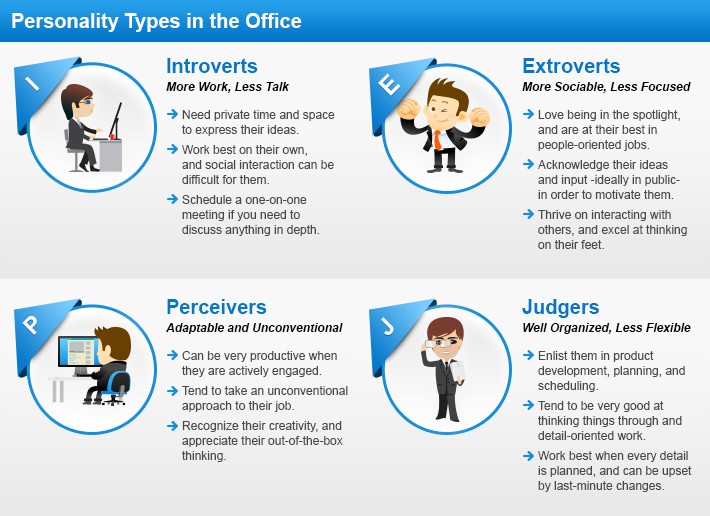
Knowing an employees personality, what drives them, and how they feel supported, can help us identify the approach to leadership that best fits their needs. We want to do our best to cater to our associates and help them overcome challenges, however, we’re not going to make everyone happy all the time. Employees need to know exactly what they signed up for when it comes to their job duties, pay, and benefits.
This will help us reiterate or further explain what they signed up for with the position if doubt or confusion sets in. We can convey this in a way that’s direct but also empathetic. And we may lose employees in the process over time, due to attrition or fallout, regardless of what we do to help, and that’s ok.
We can’t take it personal (though it does get frustrating or hurts when you do everything you can to help someone, but they still leave without notice). It’s the nature of the beast, and as leaders we signed up for it! But look at the impact you’ve had in your organization or business: the promotions, the influence on performance, your handprint on the department, you’ve done some great things!
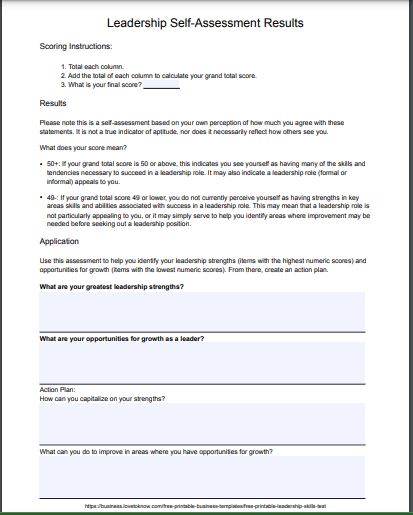
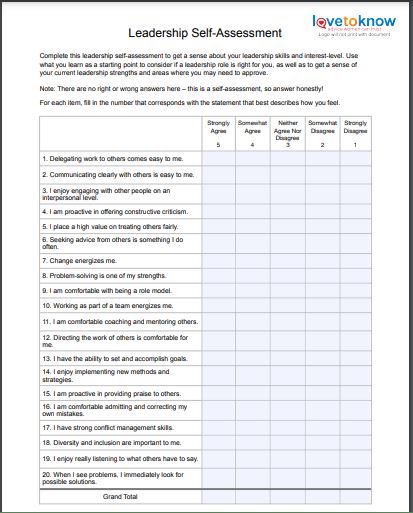
As leaders in any capacity, we can overcome adversity and create our own lane. It may be time to assess your career path as well. Shadowing other leaders and those we look up time, can help us develop our own leadership style along the way. Continue to focus on development and learning the idiosyncrasies of your team, and nuances of your department/organization. This can help us formulate a plan of action to stay ahead of the power curve. Below is a leadership assessment by business.lovetoknow.com we can take to help us identify our strengths and areas of opportunity. Stay encouraged, we got this!


 Not Your Average Boss
2 replies on “The Leadership Approach: What Works Best?”
Wonderful, thanks for sharing!
LikeLike
You got it! Appreciate you checking it out!
LikeLike