


Being a new leader in any capacity can be overwhelming: New department, new coworkers, new team to grow and develop, new challenges, are all a part of the wonder of this new journey. Finding out how we can fit in and do our part, is an essential piece of the puzzle. Identifying our leadership approach and style during our onboarding process and setting clear expectations with our team members, can benefit us tremendously.
I recently took a Leadership IQ or Leadership Styles Quiz created by Mark Murphy and it was really beneficial and self-reflective. According to the quiz, my leadership style is “Idealist.” Though a lot of the explanation made sense as I looked back over my career as a leader in corporate, some of it was self-revelatory. Below is a look at the description of a leader with an Idealist approach:
“Idealists rate high in Feeling and Challenge, and lower in Structure and Directiveness. Idealists are high-energy achievers who believe in the positive potential of everyone around them. They want to learn and grow, and they want everyone else to do the same. They’re often charismatic and draw others to them with their intuition and idealism. They’re open-minded and prize creativity from themselves and others.
Working for Idealists offers the chance to be creative and express oneself. It offers the chance to have an equal voice and learn by doing. Working for the Idealist often provides a very democratic experience. There isn’t as much process and structure as with some other leaders (like Stewards) and that can be a plus or minus depending on the employee. Idealists can often be found doing creative work, brainstorming around a table with like-minded individuals. For the appropriate people, it’s a great situation.
Employing an Idealist leadership style can deliver great results, but there are times where a leader can venture too far and employees may struggle with being pushed to continually learn and grow, especially novices or those who need a bit more structure.“
The part about venturing too far, employees struggling being pushed to continually learn and grow, and those who need a bit more structure definitely hit home. Here’s a link to the Leadership Styles Quiz if you would like to take it. There’s also a leadership assessment by business.lovetoknow.com we can take to help us identify our strengths and areas of opportunity.
As a new leader, I made it a point to make a good impression with my team, managers, colleagues, and department as a whole. I would walk the floor everyday and speak with everyone just to touch base with them. I also spent long days and nights studying resources, building a coaching plan, learning from other established leaders, and coaching each team member consistently to ensure I was meeting their needs as a leader.
In my first one on one meeting with my team members, I would work on building rapport by asking them about themselves, why they took the position, and what motivates them. I would also establish expectations and review their long and short term goals to have a clearer path to reaching them. Though some saw this as redundant or a second interview, it gave me an idea of how to best support them and what goals to work towards in the future. Repetition, initiative, and consistency is key in establishing our presence in the department as new leaders.
I also did my best to stay ahead of personal concerns or issues and made sure I was in position to field questions to the best of my ability. I led by example, was in the trenches, received praise from my team, and was even nominated for “employee of the month” in a short period of time. I say all this to show that it may seem like we’re doing good or have it all together on the surface, but underlying issues like venturing too far, pushing people too hard, and lack of consistent structure can eventually catch up to us.
My idealist approach to leadership came to a head in a team meeting where a few team members felt I was pushing them too hard. I didn’t see it at first but when they told me this, it opened my eyes further to the error of my leadership style at the time. I would say “we’re meeting expectations, but we can always do better.” Or “this was a good call but you could also do XYZ to make it better.”
This approach didn’t bode well for some. As a momentum coach in a call center, it was our job to prepare associates for production. We would focus on good things they should continue, bad behaviors they should stop, and new behaviors they should implement going forward.
I’ve found great success with this leadership style with my associates as a coach. Since I’d found success with that format or formula, I also applied it when I became a manager. Finding what works as leaders for our current team(s), comes from experience and some trial and error. I thought since I had success with this approach while coaching, I would have the same success as a manager.
However, that wasn’t the case… After allowing a venting session, apologizing, and a heart felt speech that Coach Carter would’ve been proud of, my team understood why I pushed them so hard. I saw potential in each of my team members and wanted them to be as great as possible in their position. Especially once the majority told me that leadership was one of their goals.
I did let up after that and highlighted the wins we had more than any losses we received. This slight change in my approach to leadership, helped me lead an award winning team that produced successful leaders in our organization. As new leaders, it’s vital to identify what works best for your current team as early as possible when it comes to performance and what motivates them.
Your leadership style/approach from your previous job or position may not work in your new one. We have to humble ourselves and accept that if we find that to be true based on performance and employee feedback. We also want to make sure we’re doing our due diligence to meet with our employees and address feedback consistently.
This can be challenging due to having other job responsibilities (which managers have a lot of). But becoming acclimated and successful as a new leader or even at the entry level stage, is predicated on how willing we are to learn, develop, and grow through the process. Here are a few do’s and don’ts that can lay the groundwork or foundation on our leadership style as well as help us become more acclimated to our new role:
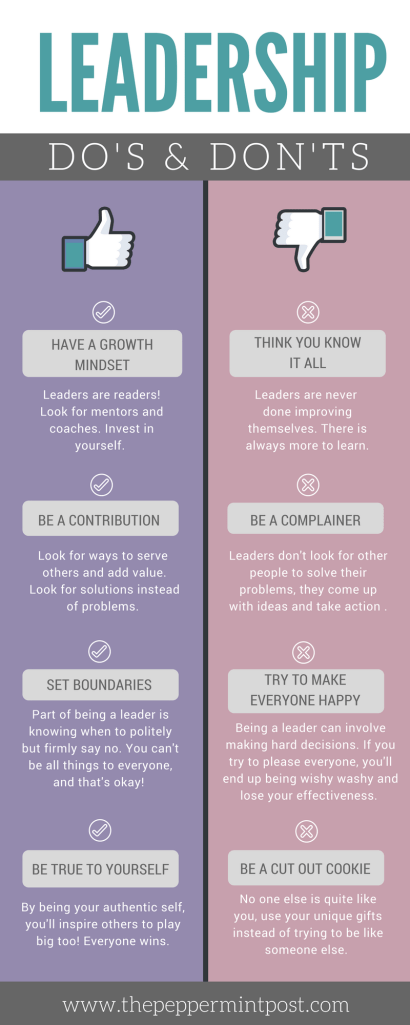
I want to elaborate on a few points from the “Leadership Do’s and Don’ts” image by The Peppermint Post.
1. Be True To Yourself- It doesn’t mean we don’t learn, shadow, or emulate other leaders we respect, but it means finding our own identity from there. You may be an introvert in your personal life and find it hard to be extroverted at the workplace. Trust me, I feel you on this. But getting out of our comfort zone consistently can help us grow. The weight of being uncomfortable gets lighter the more we push it up, so get comfortable being uncomfortable as a leader.
2. Try To Make Everyone Happy- Being a people pleaser in some regard can help build rapport. However, we don’t want to get to a place where we try to make everyone happy all the time as it can be viewed as favoritism in the long run. We want to make sure policies, expectations, and changes are communicated clearly and across the board so there’s no confusion. This doesn’t mean everyone will be happy with what was said or what’s to come, but it can bring comfort and solidarity if we communicate our opinion or highlight the positives of the change from there.
3. Being A Cut Out Cookie- Though you may model your leadership style after a mentor or colleague you admire, finding or developing your own approach from there is crucial to building strong rapport with your team. Though I didn’t have all the answers or always get it right, I worked on being a subject matter expert in my department. This helped build my confidence in the role and showed my team and department I was a reliable resource when it came to answering questions and providing support.
*If I did provide incorrect information, I would take responsibility for any backlash and advised my employee(s) of the correct answer going forward. Trying new motivational approaches (high fives, fist bumps, team shout outs, doing the wave or buying T-Shirts and Food when goals were met) helped me create and establish my own lane as a leader*
Trying different approaches can help us determine what works best regarding leadership and completing job tasks proficiently. Once we find what works and our team consistently meets metrics and are self-sufficient, we want to look at ways to keep them engaged and inspired.
Some of the ways we can keep our employees engaged throughout their tenure and during turbulent times are: Giving leadership tasks or creating leadership growth opportunities, having team members lead meetings and coach other team members using proven methods that improve metrics (start, stop, continue, highlight what’s working and what they can improve on). Putting their name in the hat for leadership opportunities with the client, can also help them buy into the vision and be involved in the continued success of your department. So I’ll leave you with this thought: Never stop learning or improving, Develop your plan of action like it’s your baby or project, and Grow with the future in mind. YOU GOT THIS!


 Not Your Average Boss