

Have you ever been to a job fair and felt overwhelmed by all the options you had to pick from? If so, you’re not alone. When it comes to career choice or career pathing, it’s important to determine our WHY to have a clearer path to a meaningful/desired career. Knowing why we want to pursue a career path, can give us more meaning, a sense of purpose, and motivation to be as effective as possible in that career field.
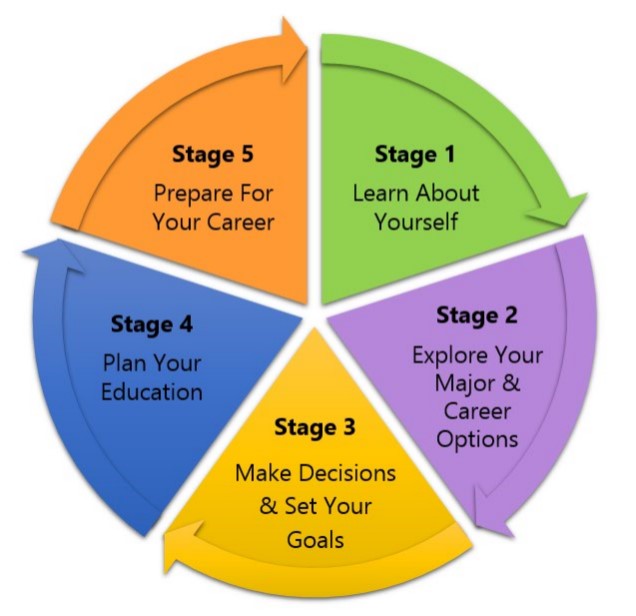
Looking at the 5 Stages of Career Development by Cypress College, we can see the importance of learning about ourselves and what our passions are when it comes to work and our career. Let’s take a closer look at each stage and breakdown how we can build a plan of action for each one.
Stage 1. Learn About Yourself- What makes you inspired or motivated when it comes to work? What’s some of your favorite hobbies, passions or pastimes? Can you make a career of these? Answer each question and make a list of 5 jobs that correlate or are inline with what inspires you and your favorite passions, hobbies, and pastimes. If a job doesn’t fit completely, that’s ok, go to the next job or career that’s close to it.
Stage 2. Explore Your Major & Career Opportunities- After you’ve made your list of 5 jobs, prioritize them with 1 being the most favorable or preferred job and 5 being the least. If your jobs require college or training based on the research you’ve done, which college do you plan on attending that offers the program, degree, or training you need?
Once you determine that and how you can enroll (student advisors, financial aid, and videos on their college can assist with next steps) look at the career opportunities associated with your degree. If you’ve already obtained your associate’s, bachelor’s, master’s, or doctorate degree(s) look at your jobs list and find companies that offer that position.
Stage 3. Make Decisions and Set Goals- This ties into stage 2 by making decisions on which school(s) you want to attend, jobs you want to apply for, and companies you want to work with. Once you narrow down the jobs list to the top 3 favorable jobs (based on inspiration, passion, salary, and career advancement opportunities) set practical goals that you can meet in a 30 to 60 day time frame.
Examples would be “this week I’m going to speak with a career counselor or student advisor.” Or “this week I’m going to research the company that has the job I want more and apply if it meets all my requirements.” If it doesn’t meet all my requirements, but is still the best option out of my 3 job choices, I’ll look into the job and company further then apply (Make sure to have an updated resume when you do).
Stage 4. Plan Your Education- By this stage, we’ve figured out if we’re going to college or specialized training to obtain the degree or skills necessary for the position. We have our roadmap of where to enroll and our next steps to completing courses and training from there. If the job we’ve selected is an entry level position where a degree is not required, look for information on the job duties and the industry to prepare yourself further for the position.
Stage 5. Prepare for Your Career- Making sure our resume is updated by this point is a good place to start once we’ve reach the FINAL stage. Does your resume fit the job requirements and description for the position? Are you able to fill out the application and submit your resume online or do you have to go in person?
If you can submit your application online, it would still be good to touch base with the company to show interest if you haven’t heard back from them in a couple weeks. Completing our Career Preparation Checklist under resources is a good tool to use as it can help you fully prepare and double check your steps before applying for a job. Career Preparation Checklist available here.
So what if you don’t want to go the traditional route of career development but want to own your own business or be self-employed? Is there a route I can take regarding this? Short answer, yes! However, it can take more time and preparation to reach this point in our lives/careers where we work for ourselves and are profitable.
If you’ve taken the necessary steps to become self-employed (manageable expense to income ratio, 3 to 6 months savings, little to no debt, passions or hobbies you can make money from but don’t need it to pay bills) then I say go for it! Even while working a 9 to 5, we can invest time, energy, and money into our business. This is actually the most opportune time to create a business model and plan for your company or hobby.
There’s more stress if you’re trying to solely depend on making money with your company as most startups don’t make money within the first year or so. If anything you lose profit in the first year or break even. There’s always expectations to this, and I hope you’re it! But let’s take a look at the Traditional Career Path vs The Protean Career Path.
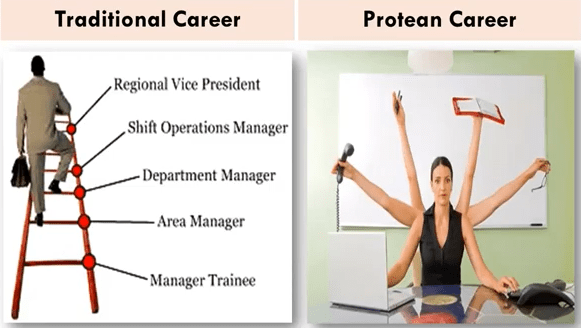
The traditional career path is where we climb the “corporate ladder” and work for an employer. The Protean career path is where we’re self-governed in our work and have our hands in different career paths based on our passions and hobbies. “The term protean stems from a metaphor of Proteus, a sea god in Greek mythology who had the gift of prophecy and used metamorphosis to hide his knowledge from others (Labour Market Search)” It also means variable or everchanging regarding career management and adaptability according to Douglass T. Hall and Jon P. Briscoe.
Is taking the tradition career path better? Or should we look into or set ourselves up for the protean path for our career? The answer lies in what you feel more comfortable with, your passions, and where you’re at mentally and economically in your life. Below is a closer look at these two career paths to help us make a better assessment.
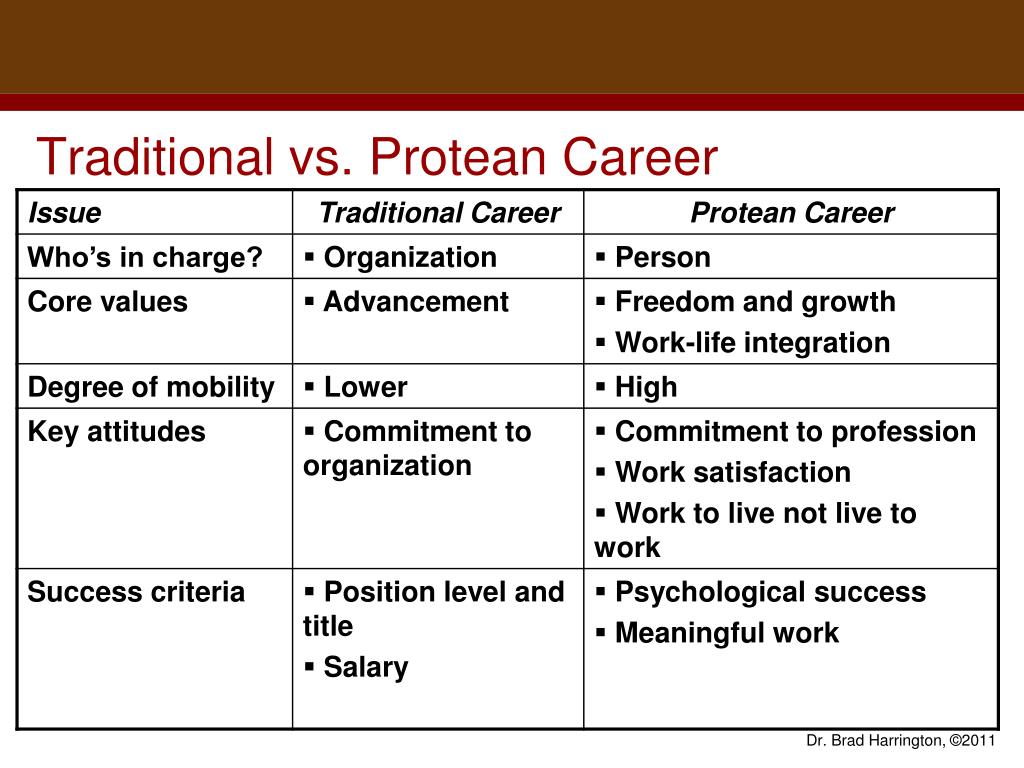
Both career paths can be fulfilling and meaningful, however, there is more freedom to operate how you feel you need to taking the protean approach to your career. Some people are more structure oriented and need more stability. The traditional career path can offer that. However, discipline, structure, and determination can still be exemplified in the protean path if you choose that route.
Most of us will start with a traditional career and work our way up from there. This is a more comfortable approach as we know we’re getting paid for the labor we do every month. The protean approach doesn’t have the same guarantee. However, it can yield a better work-life balance and more fulfillment if we’re prepared to journey down that road. It can also increase our earning potential as there is no salary cap in the protean career path.
Another career path that is sort of a hybrid of the two is a Boundaryless career where you can work for multiple employers or clients based on a contract. There is more fluidity here to move across different markets and companies based on your skills or expertise (Career Research) There’s more control of who you work for and how often you work. Commission based jobs are a good example of this (realtor, financial coach, or stock broker for instance).
Whether you choose the traditional, protean, boundaryless, or try all three at some point in your career, being fully prepared is half the battle of determining which one works best for you. For more information on what career or career path is best for you, take a FREE career assessment test from careerfitter.com who I’m affiliated with.
The full premium test does cost, however, the Free test has great information to help you on your career journey as well. Career Assessment Test This link is also available under our resources tab. Feel free to reach out to us under our Get In Touch tab for further guidance regarding your career and how we can best assist you on your journey. For our veterans who are looking to get into a career that is similar to your MOS or even a different career path, the career assessment test can assist you as well.


 Not Your Average Boss