


“Calling All Veterans” is a podcast episode I had the privilege of hosting with my long time friend and fellow veteran Scott Batista. Scott is a Legal Administrative Specialist with the Department of Veteran Affairs and has a wealth of knowledge regarding the VA claims process. The full episode of this podcast is available here and at the link under Veteran Resources at the end of this post. I also wanted to do a blog entry about it here for reference. When it comes to filing VA claims, we as veterans know how challenging and frustrating the process can be.
Though there are different organizations that can help us: VSO’s (Veteran Service Officers) VFW (Veterans of Foreign Wars) American Legion, Claim or Legal Representatives, choosing the best course of action when it comes to successfully filing our individual claim(s) can be a daunting task that’s overwhelming and discouraging. It can make you feel like giving up and not going after the disability rating/benefits you deserve.
These are the ratings you deserve based on the severity of your ailments incurred, aggravated, or related to your military service. The ratings you deserve for serving our country. Being someone who’s spent several years fighting with the VA to prove my nexus and ailments were related to and aggravated by military service, I understand how defeated we can be when those denial letters roll in. Even after we’ve submitted substantial evidence from our military and medical records that confirms our claim, it seems like the VA still fights against us every step of the way. Though they’re supposed to be on our side!
I understand not pursuing our claims any further is an option a lot of us take, especially after a higher level review or supplemental claim has been denied. But I’m writing this blog in hopes to encourage and help us be as prepared as possible when it comes to filing our claim, giving us the best chance at success.
We’re not accredited by the VA, but are veterans who’ve won claims and know the struggle of going through the process. Using different companies to help me with my claims in the past, I’ve found that they’re helpful, but are costly and borderline predatory if we don’t fully research and review our contract with them.
Some companies charge 5 to 6 times the increase you receive for their services if you win your claim. This equates to just about all your backpay if you win. They say it’s a small price to pay, but I think we deserve all our backpay or a smaller fee since we’re the ones dealing with disabilities and ailments caused or aggravated by military service.
Not saying these companies aren’t helpful and have resources to better equip us to win our claims, but if the goal is to really help veterans, they may want to rethink the cost or prices they charge. But I digress. Let’s look at some steps we can to take to file and better our chances of winning our VA claims.
PRIOR TO DISCHARGE FROM SERVICE
Service members can file for disability compensation between 180 to 90 days before discharging from service. The Benefits Delivery At Discharge (BDD) service can assist with this process. More details here. It’s also good to make sure you go to sick call or seek medical attention that’s documented when you need it. Sometimes medical concerns aren’t documented in our military records so it’s good to make sure they are before and during this process.
Service members can also file an Integrated Disability Evaluation System (IDES) claim while still on active duty. This claim deals with service members facing potential medical discharge. This process allows you to get assistance with obtaining a disability rating if your exams determine you meet criteria for medical discharge. Details here.
AFTER HONORABLE DISCHARGE FROM SERVICE
- Intent To File A Claim– An intent to file is our first step in filing a new disability claim after we leave the military or Expiration of Term of Service (ETS). We can do this online at va.gov or call the 800-827-1000 number for assistance. This starts the claims process and locks you in for a year from the date you call in or by starting the application process online.
2. Compile Medical Evidence- Next, you would start compiling your medical evidence (medical records, military records, buddy statements, nexus letters,) to prove/confirm your disabilities are related or more than likely related to your military service. Here’s information directly from va.gov in regard to gathering substantial evidence to put together a solid claim:
When you file a disability claim, you’ll have a chance to provide evidence to support your claim. Evidence could include:
- VA medical records and hospital records that relate to your claimed condition or that show your rated disability has gotten worse
- Private medical records and hospital reports that relate to your claimed condition or that show your disability has gotten worse
- Supporting statements from family, friends, coworkers, clergy, or law enforcement personnel with knowledge about how and when your disability happened or how it got worse.
As we see from va.gov, it’s important to establish our nexus (disabilities linked to military service) and that our disabilities have gotten worse since we’ve been in service. We want to be as truthful and honest as possible regarding the challenges we face with our disabilities and how they directly impact our quality of life and quality of work.
Make sure to continue to seek care for your medical concerns after you discharge from service and let your VA or primary care doctor know the severity of your issues. This way, you can get the care you need and have it documented to submit with your claim.
3. Filing Your Claim- We can also file our claim(s) online through va.gov call the 800-827-1000 number for guidance, or reach out to a local VSO for assistance. There’s plenty of good information online (Google/YouTube) to help us submit the best or most complete claim we can with the VA, but a local VSO is a good place to start if you have questions. There’s also veteran forums or Facebook groups that can help if we have further questions about the claims process.
After we follow these steps: gathered all relevant evidence (medical records, VA and private healthcare, nexus letter(s) from doctors/healthcare specialists, buddy statements that show our condition(s) are related to and have gotten worse since our military service) filled out the claim application, attached all necessary documents, and successfully submitted our claim, the VA will then reach out to us once they schedule a C&P (compensation and pension) exam. This exam is usually held at your regional VA office but is sometimes held at your local office as well.
These exams are usually an hour or more depending upon the number of disabilities we’ve submitted and evidence needed to be discussed/reviewed. You can prepare for these exams by documenting your issues especially on your worse days and how they affect your quality of life, work, and home. We can also discuss exam expectations with VSO’s or veterans in forums and Facebook groups for further guidance.
Reviewing different veteran organizations VA claims strategies on YouTube, and documenting pertinent information from them can be useful to your case as well. Having a primary care doctor document how your disabilities impair the quality of life in your records is also helpful. Private doctors can also be pivotal to our claim as they can make recommendations regarding work restrictions that confirm the severity of our disabilities.
Make sure to review your notes and verbiage before your exam and give them to the reviewer so it’s fresh in your mind on how to explain your current medical conditions and how they impact your life. Reviewers will sometimes use your notes for questions and ask you to elaborate.
This can be helpful as it can keep us on track when it comes to explaining how our disabilities impact our quality of life. After your C&P exam, it’s time to play the waiting game which can take several months before the VA reaches a decision. The more prepared we are, the better chances we have to receiving a VA disability rating that reflects the severity of our medical issues or rating we deserve. If you receive a denial letter, even after submitting a solid or well put together claim, we can follow the steps below:
IF YOU RECEIVE A DENIAL LETTER
If you receive a denial letter for your recent claim(s) we have a few options to look into.
- Higher Level Review- We can have a senior reviewer or adjudicator review our current case or claim to ensure all evidence was considered and not missed in our decision. No new evidence can be submitted with this option.
2. Supplemental Claim- If you have new medical or relevant evidence, you can add it to your existing claim/case with this option. A reviewer will then determine if your new evidence changes their decision.
3. Board Appeal- Below is information from va.gov regarding a Board Appeal:
Request a Board Appeal if you want a Veterans Law Judge at the Board of Veterans’ Appeals to review your case.
When you fill out the form, you’ll need to request the type of review you want from the Board:
- Direct review, if you don’t want to submit evidence or have a hearing
- Evidence submission, if you want to submit additional evidence without a hearing
- Hearing, if you want to have a hearing with a Veterans Law Judge (with or without new evidence)
You can request a Board Appeal online right now.
We have one year to submit for a higher level review, supplemental claim or board appeal after we receive our denial letter. Here’s more details on which route is best for your case on va.gov.
So if you’ve received a denial letter just know, the battle isn’t over! And though the success rate is low for each option, our chances of winning our case is usually greater when we submit a strong claim initially. Below are resources that can help you with your claim and better understand the process.
If you feel like you’re underrated for your disabilities or have further questions about the VA claims process, NOW is the time to take action! In the near future, we’ll be offering a Tier Level Membership Program to better assist our veteran supporters with your individual claims. We’ll be offering zoom meetings, one on one calls, and a plan of action to best maximize your chances of winning the VA disability claims you deserve. Sign up for our newsletter in our “Get In Contact” page for more details and put Tier Level Membership Program in the inquiry section if you’re interested. Thank you for your service and all that you do!
VETERAN RESOURCES BELOW
VA Claims Checklist here!
Calling All Veterans Podcast Episode https://anchor.fm/notyouraverageboss/episodes/Episode-3-Calling-All-Veterans-epfceo
VSO Assistance Information- National Veterans Foundation
Top 50 VA Claims Veterans File
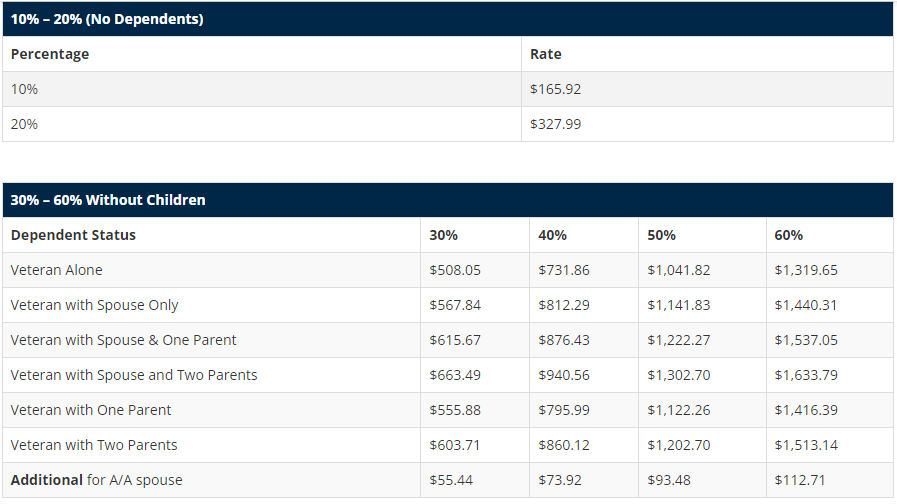
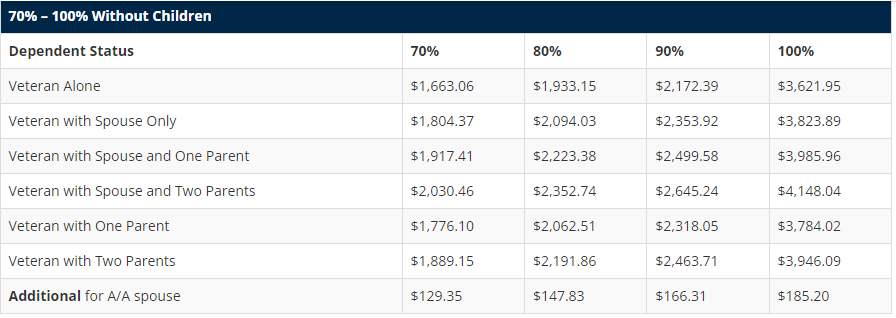
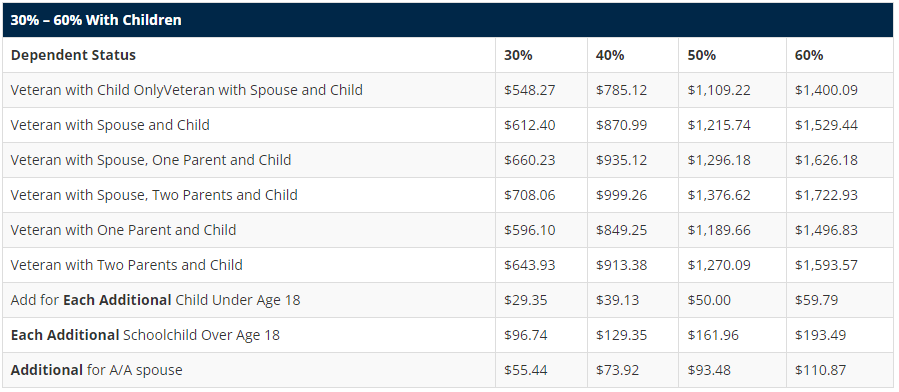
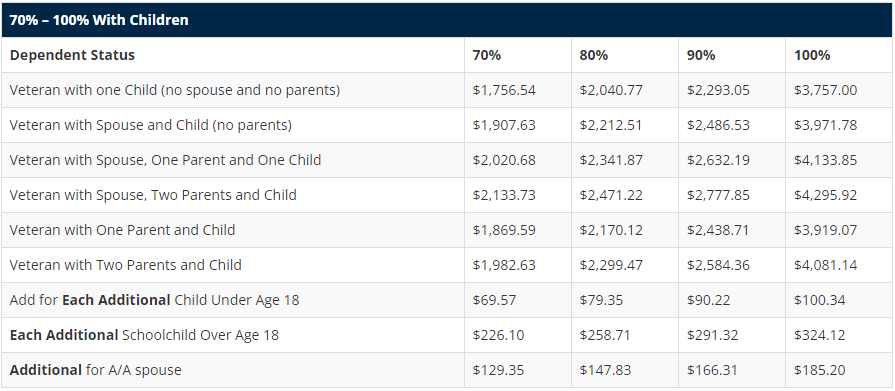
2023 VA disability pay rates, which are effective beginning December 1, 2022, currently have a year over year increase of 8.7% based on the latest cost-of-living adjustment (COLA) announcement. (VA Disability Group)
Current VA Pay Chart
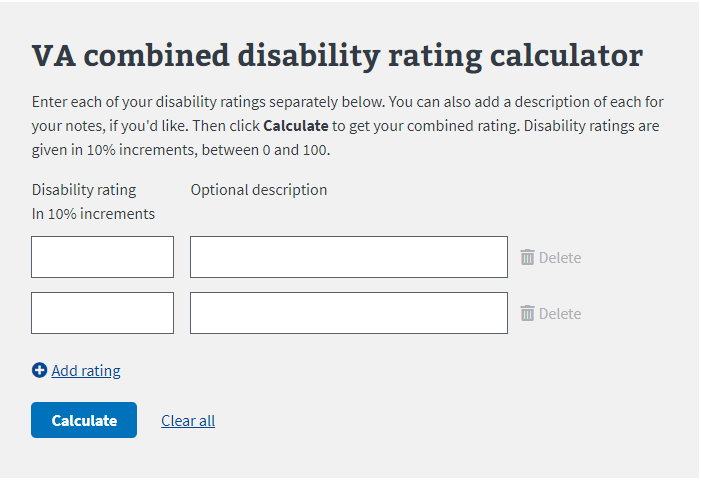
VA Disability Calculator
https://www.va.gov/disability/about-disability-ratings/
100% P&T Benefits
ADDITIONAL BENEFITS WHEN RATED 100% P&T DISABLED BY THE VA
If your rating is NOT permanent and total, you WILL be re-evaluated and the rating MAY be adjusted based on the VA’s
determination.
A veteran can be rated 100% “Total” without being “Permanent”. This usually happens when VA assumes a disability may
improve. You can tell if a 100% award is Permanent and Total (P&T) as the decision will approve “Dependents Educational
Assistance” and “Chapter 35 Benefits”.
1) VA Co-Pay Reimbursement:
If you have been paying Co-Pays and your new Rating Decision is retroactive then you can ask VA to reimburse you for
those payments back to the date of the rating.
2) Dependents Educational Assistance (DEA):
This first proves that VA has deemed your disabilities to be “Permanent and Total” (P&T). It allows your spouse and children
to be eligible for certain educational benefits.
A child is authorized 45 months of accredited schooling. VA presently pays a monthly stipend of around $805.00 for a
fulltime student. They can receive guidance counseling, tutors, etc. If a child has been in school and then the veteran
receives a retroactive benefit that includes the school dates, then the student can file for reimbursement for the months
that he/she qualified on the retroactive date.
If VA deems it needful, a student may receive an extension on the initial 45 months. A qualified student is usually 18-26
years of age, but I’ve seen some using the benefit up to 32. Usually the latter is based on a large retroactive benefit granted
to the veteran.
A spouse can also qualify for schooling.
Keep in mind that this is the student’s or spouse’s benefit drawn on the veteran’s grant. The student/spouse must handle all
of the paperwork.
3) ChampVA Health Insurance for the Spouse and Dependent Children:
This is an excellent benefit for the spouse/children. Veterans must receive their care at the VA, but their dependents can
receive care in the private sector. Please DO NOT delay in applying.
ChampVA is located in Denver, CO and they are very easy to work with. ChampVA is the spouse’s benefit so he/she will
have to coordinate with them.
VA Health Administration Center
CHAMPVA
P.O. Box 65023
Denver, CO 80206-9023
(800) 733-8387 Fax: (303) 331-7804
Email: hac.inq@med.va.gov
http://www.va.gov/hac
Of course any parent can coordinate for dependent children. The applicant will use the veteran’s Claims File number (in
upper right hand corner of the VA Rating Decision letter) in order to make the initial ChampVA application request.
VERY IMPORTANT: If a spouse/children have had any out-of-pocket medical expenses during the time of the veteran’s
retroactive grant period they can submit them to ChampVA after being approved and ChampVA will reimburse the
expenses. This can be a substantial amount if there have been significant health issue.
NOTE: ChampVA does not cover Dental, Eyeglasses and Electives.
ChampVA has a “Meds by Mail” program that is very good.
A new law was passed awhile back that gives the spouse “ChampVA for Life”. There are stipulations if a divorce is involved.
4) Dental Coverage:
All 100% service-connected veterans are allowed dental care.
Note: Veterans going through Vocational Rehabilitation are also eligible for some dental care.
5) VA Insurance:
When a veteran is deemed 100% Schedular or TDIU VA will grant a $10,000.00 insurance policy and “waive” the premiums.
A VA criterion states that you must have been granted a “NEW” service-connected condition in the past 2 years to qualify. It
cannot be an increase of an existing condition. You have only two years from the time of the decision to apply. Note: VA is
now offering this to 70% veterans. The VA insurance division will determine if you qualify.
The key on the application is to write “WAIVED” in the monthly premium amount box when applying for the 10K amount.
VA also offers other small policies, but I hear they are not very competitive.
Call this number and tell them your new rating and that you would like to file for the insurance. Contact them at 1 (800)
669-8477 or by filing online at http://www.insurance.va.gov.
6) Uniformed Services Identification Cards:
The veteran, spouse and children can apply for this card. They are very similar to our old military I.D. cards. They are issued
by the Department of Defense and allow you to access military facilities. If VA did not attach a letter/application then call your VA Regional Office and ask them to send you a Cover Letter stating
simply that you are “100% Total or Permanent and Total”. Be sure they understand that it cannot say anything less than
100%.
At the same time ask them for the “Uniformed Services I.D. Card Application”. I would suggest that you do not try
filling the application out as it’s one of the most complex one’s I’ve ever seen. Just take it with you when you apply or ask
for assistance from a Benefits Representative.
VA Regional Office: 1-800-827-1000 Call the administrative department at your nearest Military Base and ask when they do the I.D. cards. I recommend not filling out the application that is provided. It is very complex. Simply take the application and your DD-214 (You), Marriage License (Spouse) and Birth Certificates (Dependent Children). They will make the I.D. cards. The veteran’s ID is marked “PERM” and is for life. The spouse/children I.D.’s are marked “TEMP” and must be renewed every 5 years.
These cards will say “MWR” on them. This means “Morale, Welfare and Recreation”. You can use facilities at military bases
to include: Exchanges, Commissaries and Recreation facilities. The latter can include Tickets for concerts, boating, weight
room, etc. You can even rent items like boats, BBQ’s, lawn mowers, rototillers, etc. To find lots of information on MWR go to: http://www.google.com Then type in MWR.
You can also use the card for hotels/motels. I usually ask them what the rate is for AARP, AAA, etc. When they commit then
I ask them for the “Government Rate”. It’s usually a few dollars less.
We are authorized to fly “Space A” on USCG transportation
You can stay at “Bachelors Enlisted/Officer Quarters” (BEQ/BOQ) on military bases for $15-30 a night or you can use their
“Lodging” which can run $45-75. They are nice facilities.
7) Free or discounted Hunting and Fishing License/Tags:
Check your State using the link below:
http://tn.gov/veteran
8) Property Tax Break:
Check your State using the link below:
http://tn.gov/veteran
9) Golden Access Passport:
The name of this passport has been changed, but the benefits are very similar. If you have the old passport then you can
use it as the Federal government will not give you a new one.
The new pass is called “America the Beautiful – National Parks and Federal Recreational Lands Pass”.
The pass allows for 50% off Camping/recreation in Federal Parks. Some State and County Parks will honor it. Here is a link.
Be sure to take your Rating Decision letter. http://www.nps.gov/fees_passes.htm
10) To check for additional State benefits in TN go to http://www.tn.gov/veteran
11) Dependency and Indemnity Compensation (DIC):
The DIC “Clock starts Ticking” once a veteran is rated 100% “Total” or “Permanent and Total”. This allows his spouse and
dependent children under 18 years of age to receive a monthly benefit if:
a) The veteran passes of a “service-connected” disability within the first 10 years of being rated 100%.
b) If the veteran lives the full 10 years then he can pass of any disability.
Currently the monthly payment for DIC is approximately $1,400.00, so this gives the spouse about 1/2 of the veteran
paycheck when he/she was alive.
12) Travel Pay: (41.5 cents per mile)
All veterans are allowed travel reimbursement for scheduled VA appointments if they are rated 30% service-connected or
higher.
VA will also pay travel pay on a “needs basis”. This means if a veteran is under a certain income level then he/she will be
paid for scheduled visits.
VA will pay for travel to “Claims and Pension” (C&P) examinations.
13) “Independent Living Services Program” (ILSP).
This is a little known benefit designed to assist any disabled veteran to live a better quality of life despite their serviceconnected disabilities.
The program shows up briefly on the Vocational Rehabilitation Form 28-1900. I believe that VA has changed the wording
on the form to further disguise the program. In fact, they changed the name to “Independent Living Program”. Here is a
link to the VA Form 28-1900:
http://www.vba.va.gov/pubs/forms/VBA-28-1900-ARE.pdf
You’ll note on the instructions under “Rehabilitation Services” is states the following:
“If training is appropriate, VA will provide medical and dental care treatment, employment assistance to get and keep a
suitable job, and other services you may need. If a vocational goal is not currently feasible for you, VA may provide services
and assistance to improve your capacity for living independently.”
Here is a link to the Independent Living Program on the VA website:
http://www.vba.va.gov/bln/vre/ilp.htm
The Independent Living program is to make sure that each eligible veteran is able, to the maximum extent possible, to live
independently and participate in family and community life increasing their potential to return to work. Services may
include the following:
Assistive technology
Specialized medical, health, and / or rehabilitation services
Services to address any personal and / or family adjustment issues
Independent living skills training
Connection with community-based support services
13) Student Debt Forgiveness– You’ll need your DD-214 and rewards letter to confirm you’re 100 P&T disabled. You will also need to fill out and submit a Discharge Application (Total and Permanent Disability) online or a physical form which can be found here.


 Not Your Average Boss